Membership Qualification Pathway
AABC recognizes educational achievements from accredited institutions and verifies training hours to qualify members for progressive certification levels based on internationally recognized standards.
AABC Membership Qualification Pathway
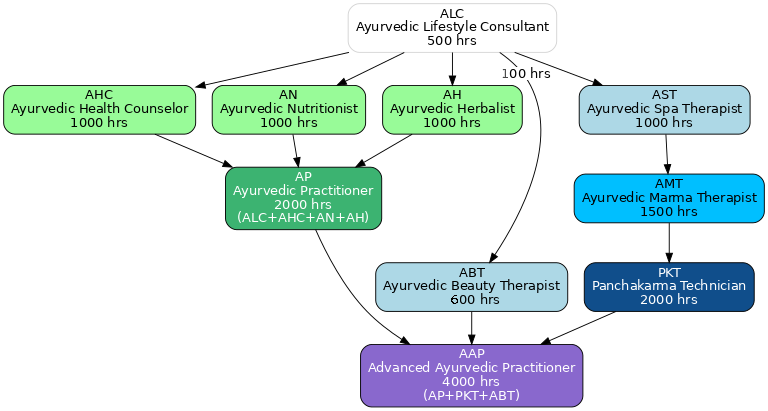
This flowchart illustrates the progression pathways for AABC membership levels, showing how each qualification builds upon previous training and leads to advanced specializations.
Foundation Level
Registered Ayurvedic Lifestyle Consultant (RALC)
Foundation level for those beginning their Ayurvedic practice journey.
📚 Education Requirements
- 500 hours foundational Ayurveda training from accredited institution
- Prerequisites: High school diploma
Core Clinical Qualifications
Registered Ayurvedic Health Counselor (RAHC)
Practitioners focused on lifestyle and dietary counseling.
📚 Education Requirements
- 1000 hours total training from accredited program (includes prerequisite hours)
- Prerequisites: RALC certification
Registered Ayurvedic Herbalist (RAH)
Specialized training in traditional herbal medicine and formulation.
📚 Education Requirements
- 1000 hours total training from accredited program (includes prerequisite hours)
- Prerequisites: RALC certification
Registered Ayurvedic Nutritionist (RAN)
Expertise in therapeutic nutrition and dietary counseling.
📚 Education Requirements
- 1000 hours total training from accredited program (includes prerequisite hours)
- Prerequisites: RALC certification
Professional Practitioner Level
Registered Ayurvedic Practitioner (RAP)
Full practitioners with comprehensive training and assessment capabilities.
📚 Education Requirements
- 2000 hours total training from accredited program (includes prerequisite hours)
- Prerequisites: RALC + RAHC + RAN + RAH (all 4 required)
Specialty & Bodywork Qualifications
Registered Ayurvedic Spa Therapist (RAST)
Specialized in comprehensive spa treatments and therapeutic wellness.
📚 Education Requirements
- 1000 hours total training from accredited program (includes prerequisite hours)
- Prerequisites: RALC certification
Registered Ayurvedic Beauty Therapist (RABT)
Specialized in Ayurvedic beauty treatments and cosmetic therapy.
📚 Education Requirements
- 600 hours cumulative total training from accredited program
- Prerequisites: 100 hours from first ALC sections
Registered Ayurvedic Marma Therapist (RAMT)
Specialized in vital point therapy and energy healing.
📚 Education Requirements
- 1500 hours total training from accredited program (includes prerequisite hours)
- Prerequisites: RAST certification
Registered Panchakarma Therapist (RPKT)
Specialized in detoxification and rejuvenation therapies.
📚 Education Requirements
- 2000 hours total training from accredited program (includes prerequisite hours)
- Prerequisites: RAMT certification
Advanced & Master Levels
Registered Advanced Ayurvedic Practitioner (RAAP)
Advanced practitioners with extensive clinical experience and specialized training.
📚 Education Requirements
- 4000 hours total training from accredited program (includes prerequisite hours)
- Prerequisites: RAP + RPKT + RABT
Registered Master Ayurveda Specialist - Vaidya (RMAS)
Highest level of recognition reserved for proven masters of Ayurvedic medicine.
📚 Education Requirements
- BAMS (Bachelor of Ayurvedic Medicine and Surgery)
- MD Ayurveda or PhD in Ayurveda
- Or equivalent: Demonstrated mastery through education, authorship, and institutional leadership
Educational Institutional Membership
Educational Institution Membership
Recognition for institutions offering AABC-registered Ayurvedic education programs.
Program Recognition
Educational institutions holding membership with AABC offer programs that are registered and recognized by the Association. Students completing courses at member institutions qualify for AABC registration at the appropriate membership level corresponding to their completed training. All programs offered by member institutions meet AABC's educational standards and prepare graduates for professional practice within the Ayurvedic field.
Member institutions ensure their curriculum adheres to AABC standards, and all instructors meet the qualification requirements for the scope of practice they teach. This guarantees that students receive instruction from qualified professionals and are prepared to practice competently within their designated certification level upon graduation.
Corporate Membership
Corporate & Business Membership
Recognition for businesses committed to professional Ayurvedic standards.
Professional Practice Standards
Corporate members include Ayurvedic wellness centers, spas, clinics, health resorts, retreats, and businesses offering Ayurvedic services or products. Member organizations ensure that all Ayurvedic practitioners providing services within their establishments are registered with AABC and practice exclusively within their designated scope of practice. This membership demonstrates a commitment to maintaining professional standards and employing qualified, credentialed practitioners in the delivery of authentic Ayurvedic care.
Verification Standards & Accreditation
International Standards
- • Complies with AAPNA (Association of Ayurvedic Professionals of NA), NAMA (National Ayurvedic Medical Association)/AAC (Ayurveda Accreditation Council) standards
- • AYUSH Ministry standards (India)
- • World Health Organization (WHO) guidelines
- • Leading Ayurveda institutions in India
Verification Process
- • Educational credential verification
- • Training hour documentation
- • Prerequisite qualification confirmation
- • Accredited institution validation
- • Professional competency assessment
- • Continuing education tracking
Stay Updated on Qualification Standards
Join our mailing list to receive updates on membership qualification standards and accredited program recognition as they become available.