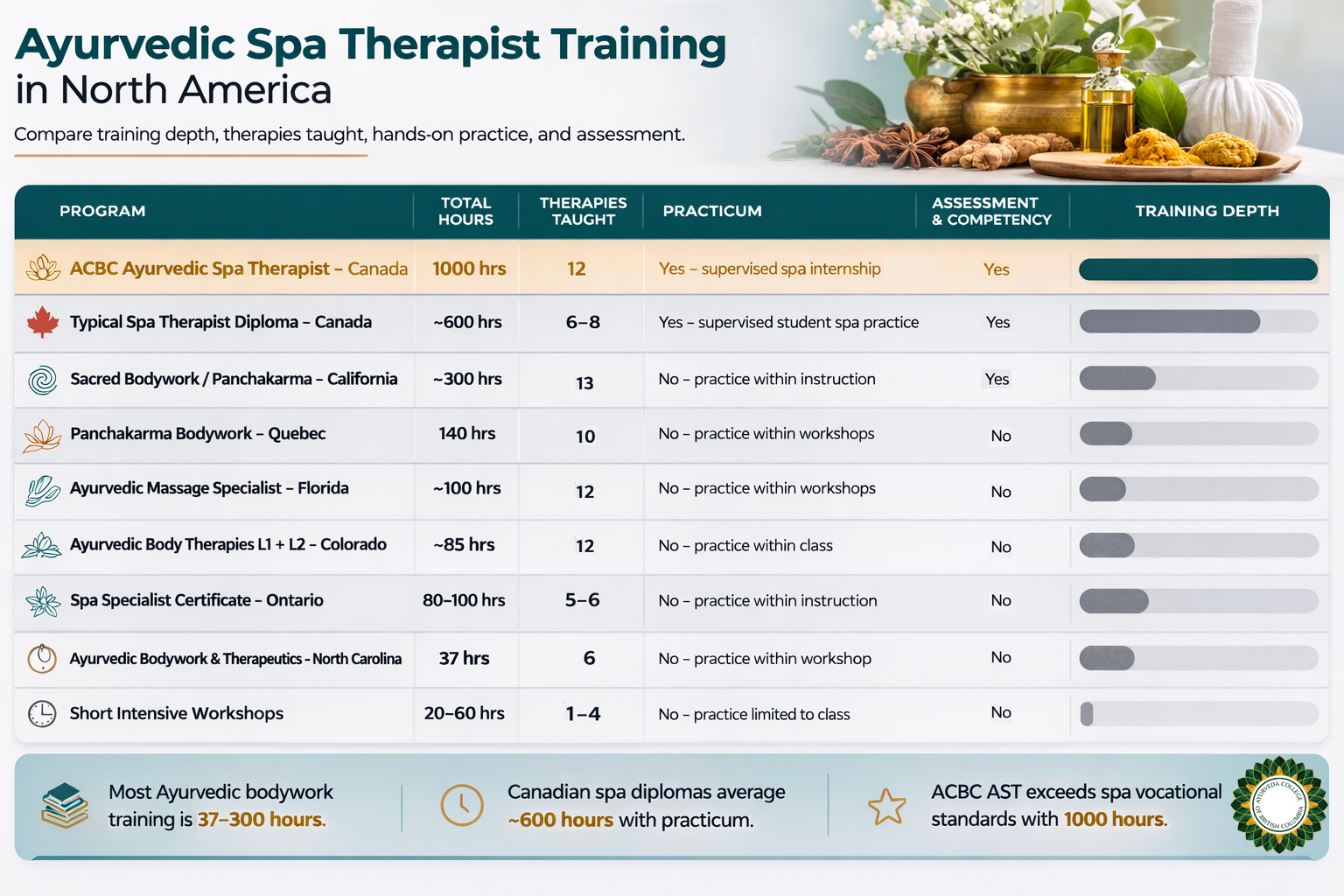
Ayurvedic therapies—Abhyanga, Shirodhara, Swedhana, and related treatments—are now offered in spas, wellness centres, and private practices across North America. Yet a medical tradition historically defined by rigorous training and disciplined knowledge transmission is often represented by programs lasting only a few days or weekends, sometimes as few as 30 hours.
This position paper examines why that discrepancy matters, how it developed, and what standards are required to ensure Ayurvedic bodywork is practiced responsibly. It is written for students, practitioners, clinics, educators, and professional organizations who care about the future of this field.
Document Contents
This position paper addresses the current state of Ayurvedic bodywork education in North America, the reasons training standards matter, and the professional pathway required to carry this tradition forward responsibly:
A Sign on the Door — Why Titles and Training Matter
Every healthcare-adjacent profession uses titles to signal training, responsibility, and accountability. When the word Ayurvedic appears on a treatment menu, the public reasonably expects a practitioner with foundational knowledge of that system—not simply someone who has learned a sequence of strokes. The paper explores this expectation and why it matters for public trust.
The Educational Telephone Game — How Knowledge Becomes Diluted
The paper traces how Ayurvedic bodywork education has degraded through a chain of transmission: BAMS physicians—whose hands-on bodywork training is typically only 50–100 hours—arrive in North America and begin teaching from that limited base. Students teach other students. With each step, Ayurvedic reasoning fades, contraindications simplify, and anatomy training disappears—until what began as a small component of a sophisticated medical system is repackaged as a weekend certification.
The Numbers — Training Comparisons in North American Bodywork
A Registered Massage Therapist in BC completes approximately 2,200 hours of formal training. A Professional Spa Therapist completes 600 hours—including anatomy, physiology, contraindications, and client safety fundamentals. Many Ayurvedic bodywork programs offer 30 to 300 hours, frequently without anatomy or clinical assessment components. The paper presents these comparisons and explains why the discrepancy is not merely a numbers issue but a structural misunderstanding of what responsible bodywork requires.
The Infrastructure Divide — Why Bodywork Became Ayurveda's Public Face
In India, Ayurveda operates within a clinical infrastructure of hospitals, pharmacies, technicians, and physician oversight. That infrastructure does not exist in North America. As a result, manual therapies become the most accessible and visible expression of the tradition—working without supervision, clinical support, or institutional safeguards. Under these conditions, education is the primary safeguard, and its adequacy carries proportionally greater responsibility.
You Cannot Touch the Body Safely Without Understanding It
Stroke direction, pressure, oil selection, duration, and treatment sequencing in Ayurvedic bodywork are not arbitrary stylistic choices. They must be adapted for physical condition, injury history, inflammatory states, tissue sensitivity, and constitutional tendencies. This section explains why foundational Ayurvedic education—knowledge of doshas, constitutional theory, and therapeutic rationale—must precede bodywork training, complementing rather than replacing anatomical instruction.
Oils Are Pharmacological Agents — Not Massage Lubricants
Classical Ayurvedic texts describe medicated oils according to their qualities, actions, and physiological effects—a field studied as Dravya Guna. An oil that soothes one individual may aggravate another if selected without understanding. The paper addresses marma anatomy (the classical network of vital points), the risks of vigorous techniques near vulnerable structures, and the neurological monitoring required for treatments such as Shirodhara. Treating these preparations as generic lubricants misrepresents both the therapy and the tradition.
Why Standards Matter — Public Safety, Credibility, and Preservation
Clear educational benchmarks address three concerns: public safety (clients deserve practitioners who understand anatomy, physiology, and contraindications); professional credibility (serious practitioners should not compete with weekend certificates carrying identical titles); and preservation of the tradition itself (Ayurveda has endured for millennia through disciplined knowledge transmission, not simplification). Without defined standards, the field risks a race to the bottom that benefits no one.
The Professional Training Pathway
The paper proposes a structured professional ladder where increasing levels of responsibility correspond with increasing levels of education. Rather than disconnected workshops, the field requires a progressive pathway that allows practitioners to develop competence gradually with clear benchmarks at each stage.
Tier 1 — Registered Ayurvedic Spa Therapist (RAST)
The foundational professional designation for Ayurvedic bodywork. Requires 1,000 hours of structured training: 500 hours of foundational Ayurvedic education through a Registered Ayurvedic Lifestyle Consultant (RALC) program, plus 500 hours of vocational bodywork training including anatomy, physiology, contraindications, client safety, 12 core Ayurvedic therapy protocols, supervised practicum, and written and practical examinations.
At 1,000 hours, this level nearly doubles the training offered in many existing Ayurvedic bodywork programs, while remaining a reasonable vocational baseline within North American bodywork professions.
Tier 2 — Specialized Therapeutic Designations
After establishing foundational competency, practitioners may pursue advanced specializations:
- RAMT Registered Ayurvedic Marma Therapist — therapeutic application of the 108 classical marma points
- RPKT Registered Panchakarma Therapist — delivery of detoxification therapies and therapeutic Panchakarma procedures
- RABT Registered Ayurvedic Beauty Therapist — traditional Ayurvedic approaches to skin health and herbal cosmetic therapies
Tier 3 — Advanced Practitioners and Educators
Teaching privileges should not arise from enthusiasm alone. Only practitioners who have demonstrated extensive training, clinical experience, and mastery should hold instructional authority. This protects both the integrity of the therapies and the credibility of the profession—and prevents the Educational Telephone Game from repeating itself in each new generation.
Core Principles
Exposure ≠ Competency
A practitioner may learn the strokes of Abhyanga in a short workshop. What they may not learn are the anatomical considerations, contraindications, pressure variations, oil selection strategies, and adaptations required for different clients. Training hours in healthcare professions are not arbitrary—they represent the time required to safely translate theory into practice.
Education as the Primary Safeguard
In North America, Ayurvedic therapists work without physician supervision, without clinical infrastructure, and without institutional safeguards. In this environment, the quality of education is the only protection available to the public and to the profession's credibility.
Standards Protect the Tradition
Ayurveda has endured for millennia because its knowledge was transmitted with discipline. When educational depth disappears, the therapies may remain recognizable—but the system that gives them meaning gradually fades. Training standards are not barriers to growth; they are the structures that allow a profession to mature.
Clarity, Not Exclusivity
The goal is not to remove Ayurvedic therapies from the spa environment or restrict access to the tradition. It is to ensure that when the word Ayurvedic appears on a treatment menu, it reflects both safe bodywork training and authentic knowledge of the system from which that therapy originates.
A Profession at Its Crossroads
The paper concludes with direct guidance for each group whose choices will determine how Ayurvedic bodywork develops in North America:
For Students
Begin with foundational Ayurvedic education before learning therapeutic procedures. Favor thorough over quick, rigorous over convenient, and in-person over online for bodywork. The credential you carry is a public statement about the standard of care your clients deserve.
For the Public
Ask practitioners: Where did you train? How many hours? Are you registered for that title? Professional titles can appear identical while representing dramatically different levels of preparation. Warm oil and soft lighting do not lower the standard of care you deserve.
For Clinics, Spas, and Wellness Centres
Elevate your standards before regulators do it for you—with far less grace. Require practitioners to hold credentials verified by an independent professional body appropriate to their scope: RAST for spa therapies, RABT for aesthetic services, advanced designations for instructional authority.
For Existing Practitioners
The emergence of clearer professional benchmarks is not criticism—it is a natural stage of professional development. Practitioners who helped introduce Ayurveda to Western audiences played an important role. As the profession matures, aligning qualifications with recognized scopes of practice protects both practitioners and clients.